Type 3: Adventurous Free Spirit
About 18% of the US population

Have the conversation
It’s critically important that you create a safe, quiet space where you can give your child your complete, undivided attention.
This sends them the message they desperately need to hear: “You are so important to me. I am here for you, and I can help with whatever is troubling you.”
Building a trusted rapport with your Adventurous Free Spirit.
Use fun activities and treats to reward positive behavior; make chores a game and fun.
Recognize that they learn best by experiencing things first-hand.
Teach them how to take “reasonable” risks, that excite, but don’t injure them.
Don’t misinterpret a lack of affection as a lack of caring.
Set crystal-clear boundaries; show them what you mean, rather than simply telling them.
This profile provides important new insights to help you connect with your child and build the healthiest, most fulfilling relationship possible.
Adventurous Free Spirits…
love to have fun, live in the moment and tend to not take things too seriously. Rather than plan things out in advance, they prefer to be spontaneous and respond to whatever is happening in the moment. As a result, they can be quite impulsive, and ignore the possible consequences of their actions. Adventurous Fee Spirits love their freedom, being independent and often take more physical risks than their parents are comfortable with.
Many Adventurous Free Spirits are naturally competitive, like to win, and aren’t usually very concerned about how the person they defeat feels about their loss. They often have excellent kinesthetic (body) intelligence, and enjoy being physical whether playing sports or being in nature. They are inquisitive and have logical minds and often enjoy taking things apart to see how they work…and can usually figure out how to put them back together again.
These are kids who don’t like being told what to do or to follow rules and will often try to bend them, whenever they believe they can get away with it.
Potential Vulnerabilities
Research shows that Adventurous Free Spirits may be at a slightly higher-than-average risk for anxiety and depression and may also be more affected by online bullying. But not all Adventurous Free Spirits are created equal, and some may be at greater risk than others. However, because every individual is unique, your child may not necessarily be at increased or decreased risk.
How to nurture your child
“Meet your child where they are.” Great advice: easy to give, and much harder to do! Stretching outside of one’s comfort zone is hard and may take practice, especially when the parent’s and child’s personality types are very different.
But it is no less important than making sure your child is safe, clothed, or fed and may be more critical to protecting their mental health and promoting their well-being. We all have gifts that make us special and for which we want and need to be appreciated.
Your Strategic Problem Solver child’s…
greatest gift is likely their ability to rise to challenges in the moment and being quick to act, being aware of everything that’s going on around them, and making things fun. Recognizing and appreciating these as some of your child’s “superpowers” lets them know that you really see them and love them for who they are.
It’s not unusual for one parent to be naturally better at having conversations that involve emotions. If this is the case, the parent who is less comfortable can learn to communicate more effectively by watching and listening to how the other parent interacts with their child.
Your Strategic Problem Solver…
child may not be very in touch with how they feel about things, or be comfortable sharing their feelings. This does not mean that they don’t have big feelings, or need their parents’ help to them deal with them…which can be challenging for parents. The best way to get them to open up is to approach them calmly, and slowly, explaining that it’s normal for everyone to feel angry, sad or scared sometimes, and that it usually helps when you talk about it. Reassure them that you’re not going to judge them. And since processing their emotions does not come naturally to them, proceed slowly.
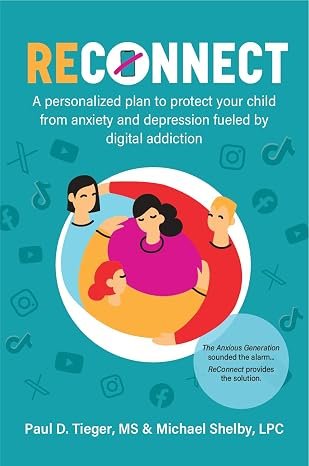
This website introduces you to your child’s personality type. Our book, ReConnect: a personalized plan to protect your child from anxiety and depression fueled by digital addiction, also introduces you to your own parenting personality with information on improving communication with all the child types.
Different personalities communicate differently. ReConnect shows you how to sidestep your incompatibilities and form trusted communication with your child.
Appendix
Children & Adolescents – Mental Health Organizations
Books
Suicide Prevention & Support Organizations
Books for Loss Survivors
Evidence-based research
The TPI-C assessment and information shared in this report are the result of the most comprehensive original peer-reviewed study of its kind involving 10,500 subjects. It established a strong statistical correlation between inborn personality type and anxiety and depression and was conducted by Paul D. Tieger and a team of researchers at a leading academic institution.
Have questions or comments?
Please contact Paul D. Tieger, creator of the TPI-C™. You can learn more about him here.
Gain a deeper understanding of your child
Please Note:
This report, generated from TPI-C™ (Tieger Personality Indicator for Children™), is provided for educational purposes only. It is NOT meant to diagnose any condition, nor does it explain or predict any future behavior or conditions in children of any personality type. Your report may indicate that children whose personality type is similar to your child’s may be at increased risk for anxiety or depression. But every individual is unique. Therefore, this does not mean that YOUR child is necessarily at increased, or decreased risk.
Copyright ©, 2026, SpeedReading People, LLC. All rights reserved.